Logistics is the business of moving things from where they are to where they need to be, and its oldest problem is not knowing where things are in between. A pallet leaves a factory, passes through a truck, a port, a ship, another port, a warehouse and a van, and at each handoff it can be delayed, lost, damaged, stolen or spoiled. For most of that journey, the owner’s knowledge is a scan at each door and nothing in between.
IoT closes the gaps. Tags and trackers report location, temperature, shock and tampering from inside the container, the truck and the warehouse, giving supply chain visibility that is continuous rather than event-based. The engineering challenge is doing this for items that are cheap, numerous, unpowered and moving between networks and countries.
This guide covers the main applications, the positioning and connectivity choices at each stage, and what separates deployments that pay from those that generate data nobody uses.
The main applications
Asset tracking. Knowing where reusable assets are: containers, pallets, roll cages, trolleys, tools, trailers. Losses and idle time on returnable assets are a large and often invisible cost, and the first tracker deployments usually pay for themselves by finding equipment that was assumed lost.
Shipment tracking. Following individual high-value or sensitive shipments door to door with a tracker inside the packaging, reporting position and condition to the shipper and sometimes the customer.
Cold chain monitoring. Continuous temperature (and sometimes humidity) logging for food, pharmaceuticals and chemicals, with alerts when a threshold is breached and a record that proves the chain was unbroken. Regulators in pharma require this record; retailers increasingly demand it for food.
Fleet telematics. Vehicle position, driving behavior, fuel, engine diagnostics and driver hours from trucks and vans, used for routing, maintenance, compliance and insurance.
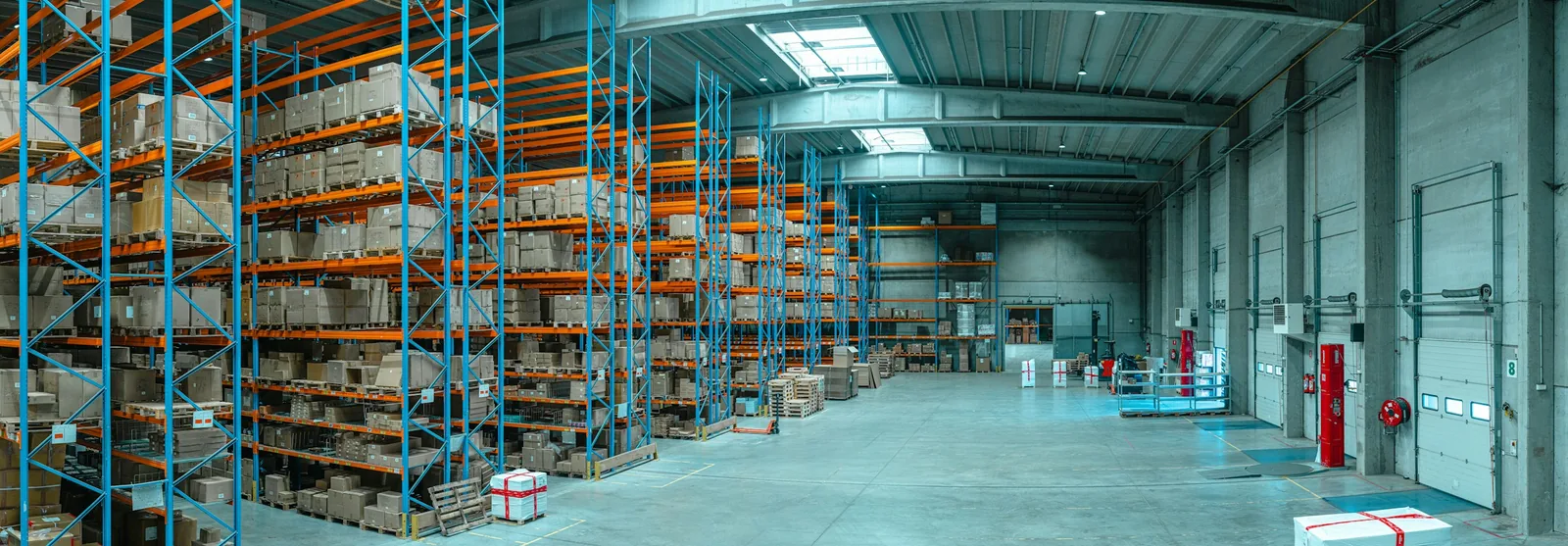
Warehouse operations. Locating forklifts, pickers and goods inside large buildings; monitoring dock doors, conveyors and AGVs; verifying that goods were put away and picked where the system thinks they were.
Positioning: where is it, and how do we know
The right positioning method depends on where the item is.
Outdoors, satellite positioning (GPS and its peers) gives global coverage with accuracy of a few meters, at a cost in power: a GNSS fix is one of the most expensive operations a battery device performs. Trackers therefore fix infrequently, or only when an accelerometer says the item has moved, and sleep otherwise.
Indoors and in dense areas, satellites fail. The common fallbacks are cellular cell-ID (coarse, but free), Wi-Fi scanning (the tracker reports visible access points and a cloud service resolves them to a location, accurate to tens of meters in cities), and BLE beacons or anchors installed in buildings. For warehouse-grade precision, UWB gives sub-meter accuracy but requires infrastructure. RFID portals at doors give presence rather than position: the item passed this point at this time.
Good trackers combine methods and choose the cheapest one that gives useful accuracy for the moment: GNSS on the highway, Wi-Fi in town, BLE in the warehouse, nothing while stationary.
Connectivity along the journey
A shipment passes through environments with different networks, and no single radio covers all of them.
LTE-M and NB-IoT are the usual backbone for anything that travels on roads: they work across most of a country, support roaming, and LTE-M handles motion well. International shipments need a SIM or eSIM with multi-country agreements, and the device should fall back gracefully when no network is available, logging locally and uploading when coverage returns.
Inside warehouses and yards, LoRaWAN and private networks cover large sites cheaply for stationary assets. BLE tags on pallets and cases are read by gateways at doors and on forklifts, so that cheap tags with no cellular modem still report their presence as they move through a facility. In a container at sea, nothing reaches the outside world except a gateway with satellite IoT backhaul, so tags inside the container talk to that gateway over BLE and the gateway relays.
This layered design is common: thousands of cheap BLE tags on items, dozens of cellular or satellite gateways on vehicles, containers and sites, and the gateways doing the long-haul reporting. It is the only way to track at item level without putting a modem on every box.
Condition, not just location
For many goods the question is not where the shipment is but whether it is still good. Temperature loggers for pharmaceuticals, shock and tilt sensors for fragile equipment, light sensors to detect a container being opened, and humidity for paper and electronics turn a tracker into a condition record. The value is in the record as much as in the alert: a complete temperature history is what lets a pharmacy accept a delivery, and what lets a shipper assign responsibility when a shipment is spoiled.
Condition sensing has a design subtlety: the tracker must log even when it cannot transmit, with timestamps that survive clock drift, and upload the gap-free log later. A device that only reports when connected proves nothing about the hours in a refrigerated hold.
From data to action
A location feed on a map is the first thing every deployment produces and the least valuable. Returns come from decisions the data changes: rerouting a delayed shipment, recalling a load that broke temperature before it reaches a store, rebalancing containers to where they are needed, dispatching maintenance on a truck whose engine reports a fault, cutting the number of pallets bought because fewer are lost.
That requires the data pipeline to reach the systems that plan and execute: transport management, warehouse management, the ERP. Integration with those systems, through APIs and standard event formats, is usually the larger part of the project. Standards bodies in logistics have defined event vocabularies for supply chain visibility that make this easier when both sides use them.
Practical constraints
Trackers on returnable assets must survive years without service, which means long battery life, rugged housings and the discipline to design for motion-triggered reporting. Trackers on single-use shipments must be cheap enough to lose, or recoverable, which pushes toward reusable units in returnable pouches. Hazardous goods and air freight restrict batteries and radios; air cargo trackers must comply with airline rules on transmitting during flight. And ownership of data across a multi-party chain, where the shipper, the carrier and the receiver all want visibility, has to be agreed before the first tracker ships.
Where to go next
- Bluetooth Low Energy for IoT covers the tag radio that makes item-level tracking affordable.
- NB-IoT and LTE-M explained explains the cellular backbone for mobile assets.
- LoRaWAN explained covers site-level networks for warehouses and yards.
- The IoT data pipeline shows how tracking data reaches the systems that act on it.
Topics: logistics, supply chain, asset tracking, cold chain, telematics